Rahat · open source · Apache 2.0
The platform under Miya.
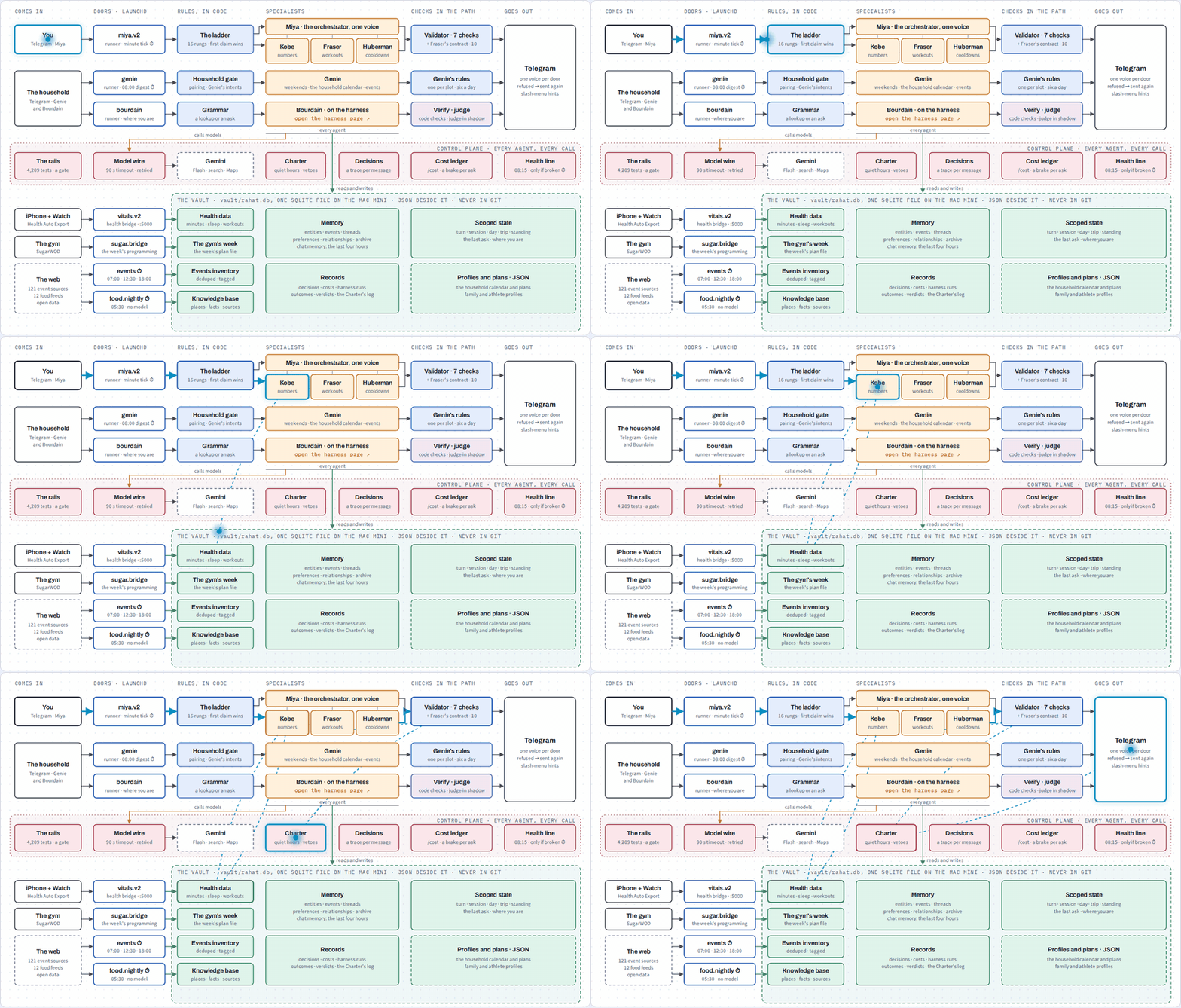
Miya is the one I talk to. Rahat is everything underneath: specialist agents that prove themselves on their own front door before they join Miya, checks in the path, a harness every answer runs through, and a record of every decision. It runs on a Mac mini at home, around the clock.
- 7agents
- 3front doors
- 4,209tests
- 72real asks in the eval set
- 7,408decisions logged
Counts as of Oct 17, 2026. Every one is in the repo.
See it move
The whole system on one page. Tap any box, or watch a message travel.
Open the map → InteractiveInside one agent
The eight-step harness every answer runs through, from understanding the ask to recording the run.
Walk the harness → GitHubThe code
The architecture, the decision records and the tests. Open source under Apache 2.0.
Read the code →What's running today
Checks in the path, not requests in the prompt
- A validator on the way out. Miya's replies are checked against what's actually true, with seven checks, and rewritten before they send. Fraser's workout designs pass a 10-point contract in code: one repair if something fails, and if it still fails, the reply says what isn't verified.
- A harness for agents. Eight steps from understanding the ask to recording the run, with the outcomes each answer must meet checked in code. One agent is on it (Bourdain), and a second uses its contract (Fraser).
- A judge that has to earn its vote. A second model grades what code can't, like taste and fit. It stays in shadow until it agrees with my own labels: 80% on at least 50 of them before it may annotate, 90% on one outcome before it may block. Today it is all shadow.
- Knowledge with receipts. Every fact in Bourdain's knowledge base carries its source and the date it was read: 326 places and 3,397 facts as of Oct 14.
- Evals that replay for $0. Every model and tool call is recorded against its request, so a run replays without a network or a bill. The golden sets are 72 real asks, kept private; the public tests run on synthetic twins.
- A decision ledger. One row per decision, with the agent, the rule, the latency and the cost.
- 4,209 tests behind a pre-push gate that blocks anything red.
How an agent joins
Prove it on its own door, then join Miya
I don't add an agent straight into the assistant I talk to. Each one starts on its own front door, with its own bot and its own tests, where its failures are easy to see and can't break anything else. When it passes, it's wired in behind Miya, and Miya stays the one place I ask. Genie came in that way. Bourdain is next.
Orchestration is the part I'm least done with. Today a ladder of rules in code answers the asks it recognizes, and Miya's model handles the rest. Routing each ask by what every agent declares it can do is planned, not built.
Honest scope
Personal scale, real problems
Rahat is not enterprise software. But a fluent agent that's confidently wrong, agents that disagree, a decision you can't prove, an evaluator you can't trust: those are the problems a company hits the day it runs a fleet. Solving them in a house, where I feel every failure the same day, is an honest way to learn them.
Get each new post by email
The writing goes out on Substack. Every post also lands here, searchable.